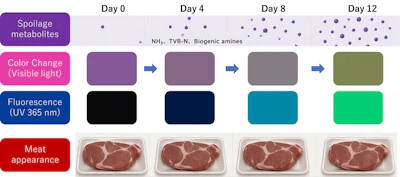
Food spoilage causes chemical changes that are not always easy to detect by appearance alone. To better indicate freshness and quality, researchers at Kyushu University developed a smart packaging film that changes color and glows under ultraviolet (UV) light as meat loses freshness.
Tested with refrigerated mutton, the film responds to compounds released during spoilage, offering two ways to track changes in food quality. The findings were published in the Chemical Engineering Journal on November 1, 2026.
Food packaging is generally designed to protect food from the external environment and spoilage, but it typically provides little information about food quality. Certain food components can act as freshness indicators and provide additional information about their condition.
Anthocyanins, for example, are natural plant pigments that change color as acidity changes, making them useful for detecting chemical changes associated with food spoilage. However, these color changes can be subtle during early stages and may be affected by lighting conditions.
A research team led by Professor Fumihiko Tanaka and Associate Professor Fumina Tanaka of Kyushu University’s Faculty of Agriculture set out to address this challenge. Working with collaborators from Nanjing Agricultural University in China, Ghent University in Belgium, and Nguyen Tat Thanh University in Vietnam, they aimed to develop a more reliable and sensitive method for monitoring food freshness in real time.
“We wanted to combine color changes with fluorescence to make signs of spoilage easier to recognize,” says Xirui Yan, a JSPS researcher at Kyushu University and the paper’s first author. “Color provides a simple visual indication, while fluorescence under UV light offers a clearer signal when color differences are difficult to see.”
The team used casein, a protein found in milk, as the film's base. To make it respond to signs of spoilage, they added anthocyanins extracted from black soybean seed coats. These natural pigments change color with acidity, and treating them with pyridine also gave them a fluorescence response. The modified pigments were then combined with zeolitic imidazolate framework-67 (ZIF-67), a porous metal–organic framework material, and incorporated into the casein film.
The researchers tested three film formulations containing increasing amounts of ZIF-67 to see how well they tracked freshness and helped preserve refrigerated mutton. The second formulation, called Z2, provided the best overall balance of sensing performance, preservation properties, and material use. The films also showed improved water resistance, antioxidant activity, and antibacterial activity compared with casein-only films.
As spoilage progressed, the mutton released ammonia and other volatile compounds that triggered changes in the film. The optimized Z2 formulation showed a clear fluorescence response from around day six under 365-nanometer UV light. Under ordinary light, the films also showed gradual color changes during storage. Together, these signals provided two ways to track changes in freshness.
Moreover, the films showed substantial disintegration and mass loss under the tested soil-burial and seawater conditions, suggesting potential for packaging that leaves less persistent waste. However, the disintegration results do not establish complete mineralization or long-term environmental safety. Future studies will need to test the films with other foods and under real supply-chain conditions, as well as assess their stability, safety, scalability, and cost-effectiveness.
The films could have applications in smart food packaging, giving consumers, retailers, and distributors an additional visual indication of freshness alongside conventional date labeling. By making quality changes easier to recognize, the researchers hope to enhance food safety, reduce unnecessary food waste, and support sustainable food-packaging technologies.
“As food packaging evolves from passive protection to intelligent sensing, our film provides smart sensing that could ultimately support smartphone-based and artificial intelligence-assisted freshness monitoring,” concludes Fumihiko Tanaka.
For more information, read “A casein-based dual-mode smart film enabled by pyridine-modified anthocyanins and ZIF-67 for real-time mutton freshness monitoring."