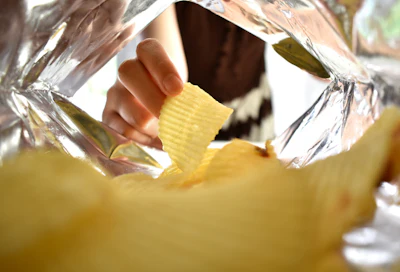
Pick up a bag of chips, and you're holding a small case study in polymer science complexity. That bag likely contains 10 to 11 distinct layers of material, including a sealant layer, adhesive tie layers, a metallized barrier layer, more tie layers, and a printable outer layer. Each one of the main layers exists to provide a different function (flexibility, sealing, barrier) and the tie layers keep all of those incompatible materials stuck together.
For food brands’ supply chain and procurement teams, these tie layers deserve more attention than they typically get. Each one is a separate resin to source, qualify, and manage through inventory. Each one adds a supplier relationship and a potential point of failure. And collectively, they add weight and material volume that show up in freight costs, and increasingly, in the extended producer responsibility (EPR) fees that a growing number of states now charge based on packaging weight and ease of recyclability.
What looks like a few microns in a film structure can multiply into meaningful cost and complexity across millions of packages.
Why the Tradeoff Exists
Flexible food packaging has to satisfy competing demands simultaneously. It needs enough flexibility to survive forming, transportation, and storage handling, and a consumer's hands, without puncturing. It also needs enough barrier performance to keep oxygen and moisture from impacting the product's quality throughout its shelf life.
That tradeoff means more materials to qualify, more complexity on the manufacturing line, and a finished package that's difficult to recycle because those bonded layers can't be separated back into their component materials.
Not every barrier material in that stack is a candidate for replacement. Metallized film, the barrier layer behind a bag of chips, remains the best oxygen and moisture barrier available, and few options exist to replace it at the same performance and cost. The more interesting opportunity sits in the much larger category of flexible packaging that doesn't use metallization at all.
The Overlooked Complexity in Clear Packaging
Walk past a shelf of clear pouches, stand-up bags, and film-wrapped products, the packaging that doesn't look nearly as engineered as a metallized chip bag, and you're looking at structures that often carry 5 to 7 layers of their own. Most consumers never register this, because there's no shiny foil cue signaling "complex packaging" the way there is with a snack bag.
But the same underlying tradeoff is at work. A barrier polymer, typically EVOH, has to be sandwiched between materials that protect it from moisture and give the package flexibility, held together with the same tie layers doing the same job.
Unlike the chip bag, EVOH-based clear film systems have the opportunity today to be reimagined in a way where adhesive layers become less important or even obsolete.
What Changes With Nanolayer Architecture
Nanolayer coextrusion arranges commercial, already-approved polymers into hundreds or thousands of alternating microscopic layers within a single film rather than laminating a handful of thick layers together. When those layers are squeezed down to the nanoscale, the interfaces between them, where one polymer meets the next, begin to dominate the overall performance. Different materials start to act together like one and adhere easily. The tie layer, in effect, becomes unnecessary.
Applied to an EVOH-based clear packaging structure, that shift can meaningfully reduce the number of different materials used while maintaining or improving oxygen barrier performance. The same confinement effect that removes the need for tie layers also makes EVOH itself more efficient through confined crystallization, meaning less of it is needed to hit the same performance target. These structures can meet the Association for Plastic Recyclers (APR) design guidelines for recyclability, rather than a bonded composite that recycling infrastructure can't easily process today.
This isn't a claim that nanolayering solves flexible packaging's recyclability problem outright. It's a step toward simpler, more recyclable structures in a large slice of the category where the barrier material itself is one that nanolayering can actually work with. And critically, it doesn't need new materials requiring new regulatory approval or years of qualification. It uses the same polymers already cleared for food contact use, in a different architecture that pushes the performance further.
Why This Belongs on a Supply Chain Agenda
Sustainability commitments and cost reduction are usually treated as separate initiatives with separate budgets however often they can be tackled together. Fewer layers means fewer materials to source and qualify, fewer suppliers to manage, less total packaging weight moving through the supply chain, and a structure that's more likely to fit within existing recycling infrastructure.
The chip bag is a useful entry point precisely because it's ordinary, and its complexity is visible. But the bigger opportunity, and the one worth a supply chain team's attention, sits in the far larger volume of clear, flexible packaging carrying similar complexity that most people never notice. Rethinking that architecture is a chance for brand leaders and packaging converters to remove a cost and a compliance liability that the industry has learned to build around, in the categories where that's actually achievable today.
Most supply chains have assumed that tie layers are always a necessary part of food packaging. Alternative architectures through nanolayering are here to challenge that assumption.