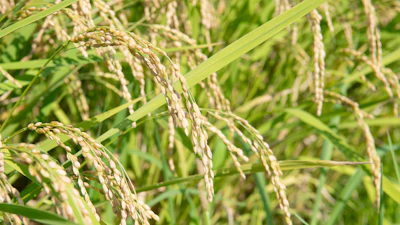
Oryza rufipogon is an ordinary-looking wild grass found today in parts of China, India and Southeast Asia. More than 8,000 years ago, people living in the Lower Yangtze Valley began cultivating it.
Like any other wild grass, O. rufipogon releases its seeds to the ground when ready to propagate new baby plants. Perhaps inadvertently at first, people selected rare individual plants that failed to release their seeds, kept an upright posture and had other traits that made it easier to harvest their seeds for food.
Over time, people brought together a combination of traits in the cultivated grasses that made them distinct from their wild ancestors – an act of genetic modification through selective breeding that long preceded the establishment of genetics. The crop they created is recognized today as Oryza sativa subspecies japonica, or domesticated Asian rice.
It's one example of how, around the end of the last ice age 11,700 years ago, people all over the world independently started directing the evolution of local crops. This process had far-reaching consequences. From the chinampas – the floating maize or corn gardens – of the Aztecs in Mesoamerica to rice paddies in East Asia, to wheat fields in the Fertile Crescent in Southwest Asia, domesticated crops supported the establishment of large, stationary populations through mass labor and food surpluses, paving the way for the emergence of modern societies. Crop domestication can stake a claim to being among the most pivotal technological advances in human history.
Societal impact aside, domestication is a unique evolutionary process driven by a domesticator species – such as humans – exerting control over the reproductive success of a domesticated species, such as rice. Domesticated crops are therefore powerful systems by which to study recent, rapid adaptation.
I'm an evolutionary biologist based in Michael Purugganan's lab at New York University, where we use genomics to study the processes of rice's domestication and subsequent dispersal. We're interested in when and how the crop spread from its center of domestication in the Lower Yangtze region of modern-day China, and what genetic changes underpinned domestication and allowed adaptation to new environments.
Genetic questions about crop domestication
It is clear that crop domestication entails genetic change. But how much genetic change constitutes complete domestication? Are there a small number of dramatic changes in key genes, or hundreds of small changes across the genome?
Researchers have identified key, large-effect genetic changes in several crops. For instance, mutations in its SH4 and qSH3 genes cause domesticated rice to lose the ability to "shatter" – that is, release its seeds to the ground. Newer studies indicate that numerous genome-wide changes, not only a few mutations in single genes, are important for crop domestication and diversification. Nevertheless, known domestication-linked mutations provide a way to study the history of traits such as nonshattering, cold tolerance and the time taken to produce flower or grain.
My colleagues and I were particularly interested in a set of questions related to the timeline or tempo of domestication and later geographic spread of rice. Were the traits that people value – and their underlying mutations – already present in the wild? Or did they emerge under human selection as people cultivated these plants? Was domestication a rapid process, or did it take place over thousands of years?
These questions are fundamental to understanding the process of domestication. They may help us understand the relative roles in this process between deliberate human choices and unconscious selection. In other words, were people intentionally picking the most desirable plants for breeding? Or was there something about just being grown in human-modified environments that led slowly and inadvertently – at least initially – to the rise in frequency of certain traits?
New tools reveal history of crop domestication
New methodological advances over the past decade help scientists estimate the age of mutations and reconstruct how their frequency in a population has changed over time.
All of the rice plants we have sampled from across East, South and Southeast Asia are related to each other. A process called recombination shuffles around parental genomes during sexual reproduction. Each shuffled region of the genome – or genomic block – produced through this process has its own genealogical history.
Researchers are now able to estimate how far back in time two individuals diverged at each block based on the number of differences that have accumulated between them, and the known mutation rate in rice. We may represent the relationships between individuals at a genomic block as a tree, with nodes representing common ancestors and the branch lengths representing time. If branches of the tree containing a mutation of interest appear very flat, that possibly indicates rapid recent rise in the frequency of the mutation.
In the absence of time travel or well-preserved ancient DNA for many crops, these methods provide a way to study the history of mutations underlying major agricultural traits, especially traits such as cold tolerance that cannot be gleaned from archaeological remains.
My colleagues and I were not alone in recognizing this potential: In 2025, studies on corn and adzuki beans, alongside our own study on japonica rice, revealed that mutations linked to domestication traits were often present at low frequencies in wild progenitor or pre-domesticated populations. They rose to high frequencies over the course of thousands of years after people began cultivating the crops.
During corn domestication, a single mutation in the gene tga1 resulted in exposed kernels, distinct from the stony exteriors of the wild ancestor crop. Scientists had hypothesized that exposed kernels emerged during domestication; they assumed the trait would not have survived in the wild because it would have left the crops vulnerable to pests and predators. The 2025 study, however, showed that the mutation dates back to more than 40,000 years ago – long before the domestication of corn about 9,000 years ago.
The adzuki bean study found that two mutations linked to the domestication trait of seed coat color and one linked to pod shattering began rising in frequency thousands of years earlier than the origin of domesticated varieties, implying a long period of cultivation and possibly unconscious selection before the emergence of fully domesticated varieties.
In our study on japonica rice, we examined more than 70 key mutations linked to domestication and subsequent local adaptation. We found that a mutation in the qSH3 gene underlying nonshattering seeds was likely present in the wild ancestor and rose in frequency over a period of more than 2,000 years, starting from about 9,000 years ago. The frequency trajectory precisely matched the rise in the frequency of the nonshattering trait observed in seed remains that archaeologists found at sites in China's Yangtze Valley.
We also found that even later innovations, like the evolution of cold tolerance during the emergence of temperate japonica about 4,000 years ago, frequently made use of ancient, preexisting genetic variation.
Collectively, these studies underscore the importance of standing genetic variation in the origins and evolution of domesticated crops. In addition, these findings match up with a prevailing idea among archaeologists that early crop domestication was often a slow, multistage process taking place over thousands of years.
This article is republished from The Conversation under a Creative Commons license.