When production lines run around the clock, manufacturers do not have much room for uncertainty. A few seconds of downtime can ripple across a plant, delay shipments, disrupt customers and create costly knock-on effects across the supply chain.
For years, that reality made cloud adoption in manufacturing feel risky. Latency, cybersecurity, reliability and real-time machine control all seemed to argue for keeping critical systems close to the factory floor. In many cases, that caution was justified. What's changing now is less about whether cloud belongs in manufacturing, and more about where cloud can help manufacturers make better decisions without compromising the speed, reliability and control that production environments require.
In a recent conversation on The Future of Supply Chain podcast, IBM’s Shaun Mitra made a point that reflects how quickly the discussion is evolving: cloud-based manufacturing solutions are increasingly becoming a foundation for how modern factories operate, not because factories are moving entirely to the cloud, but because manufacturers need better ways to connect systems, data and decisions across the business.
That distinction matters. Cloud is no longer just where manufacturing software lives. It is becoming the connective layer that helps manufacturers bring together planning, production, logistics, maintenance, engineering and execution across increasingly complex operating environments.
Advances in edge computing, cybersecurity, AI and data management are accelerating this shift. As manufacturing operations become more interconnected, organizations are looking for new ways to bring together data from across their business and create a more complete picture of their operations.
The factory floor isn’t disappearing
The biggest misconception about cloud in manufacturing is that it somehow means moving the factory into the cloud. It does not. The machines, programmable logic and real-time controls still live on the shop floor. Manufacturers will always need local execution, local reliability and local expertise. The point is not to run the production line from the cloud but to use the cloud to make better decisions around the production line.
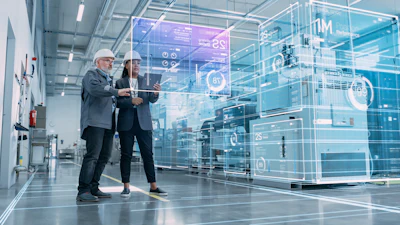
That is why manufacturing is entering a hybrid era in which physical execution remains local while analytics, orchestration, AI models, digital twins and cross-plant visibility increasingly sit in the cloud. This gives manufacturers a way to connect what is happening inside one plant with what is happening across the broader network.
Take, for example, a global manufacturer with facilities across multiple regions. By using a cloud-based platform, leaders can instantly compare performance across plants, predict maintenance failures before they happen, understand how a design change impacts production in near real time, and use AI to continuously optimize schedules, quality and energy usage.
These capabilities have existed in fragments for years. What’s changing now is their ability to scale manufacturing operations and connect them across the broader business. That is the real promise of cloud in manufacturing. Not abstraction. Not modernization for its own sake. Better visibility, faster response and more confidence when conditions change.
The real challenge isn’t technology
Cloud adoption in manufacturing is often framed as a technology story. But the harder challenge is organizational.
While technology is driving the cloud conversation, successful adoption depends on more than just software. Manufacturers have to effectively manage their workforce, especially as experienced operators retire and digital systems become more sophisticated. As a result, change management has become just as important as technology deployment.
Beneath the AI, automation and cloud strategy is a very human reality: operators want to understand how technology will help them do their jobs better. Organizations that invest in their workforce and create environments where employees can make faster, smarter decisions, will be the most successful.
The future factory may be closer than you think
For years, the factory of the future felt like a distant vision. Today, many of the technologies associated with that vision are embedded in everyday operations.
Manufacturers are gaining access to more connected data, broader operational visibility and increasingly sophisticated analytical capabilities. As a result, teams can identify issues earlier, understand the impact of decisions more quickly and respond to changing conditions with greater confidence.
Factories will remain physical and humans will remain essential. But decision-making is becoming increasingly digital, connected and intelligent. As manufacturers seek greater resilience, efficiency and responsiveness, the ability to connect information across functions and facilities is becoming increasingly important.
The future factory is not an isolated site operating independently from the rest of the business. It is part of a connected manufacturing network where information moves more freely, decisions are made with greater context and operational intelligence extends beyond the walls of a single facility.
The organizations that will succeed in the years ahead will be able to connect information across functions, turn insights into action and create greater visibility across the business. While the cloud is not new to manufacturing, its evolving role in enabling connected operations is shaping the next chapter.
Richard Howells is the vice president of marketing of supply chain solutions at SAP.