The food manufacturing facility staff members that the Nalson-Jameson team speaks with each day have a common challenge – they need to balance tight production schedules, rising operational costs, and compressed Clean-in-Place (CIP) windows. However, sanitation can’t be viewed as a simple routine task performed at the end of a shift; it’s crucial in your operations and can directly impact public health, regulatory compliance, and your plant uptime.
While much of the focus is on high-visibility processing machinery, the utility washdown equipment (think mixing units, hot- and cold-water stations, washdown hoses, and spray nozzles) forms the primary front line of plant hygiene. Neglecting this equipment introduces subtle risks which can escalate into costly downtime, failed audits, or safety hazards. Transitioning from reactive repairs to a structured preventive maintenance program for washdown equipment is essential for protecting food safety, safeguarding workers, and optimizing total ROI.
Compliance and Operational Drivers: Beyond the End-of-Shift Spray
Food safety failures frequently stem from gaps in sanitary operations, facility controls, and equipment maintenance. Under the FDA’s Food Safety Modernization Act (FSMA) current Good Manufacturing Practices (21 CFR Part 117) and USDA sanitation performance standards (9 CFR Part 416), food processing facilities are required to maintain cleanable, well-maintained food-contact and non-food-contact surfaces. Furthermore, stringent Global Food Safety Initiative (GFSI) benchmarks—such as SQF, BRCGS, and FSSC 22000—demand continuous hazard prevention rather than reactive cleanup.
Washdown systems deliver the precise water temperature and pressure required to strip organic soils, proteins, fats, sugars, and allergens from equipment frames, conveyors, tanks, and floors. When washdown equipment malfunctions—whether due to fluctuating water temperatures, pressure surges, leaking or clogged nozzles and mixing units—sanitation efficiency drops immediately.
The operational consequences of compromised washdown equipment are severe:
Failed Pre-Operational Inspections: A failure during pre-op checks delays line startup, generates unplanned overtime, increases chemical and water consumption, and creates friction between quality assurance and production teams.
Microbial and Allergen Risks: Inadequate pressure or incorrect temperature leaves organic films intact, creating harborage sites for pathogens like Listeria or hiding allergen cross-contamination risks.
Cross-Contamination: Damaged hoses or overspray can splash contaminants onto post-pasteurization or ready-to-eat (RTE) processing lines.
The 5 Pillars of Washdown Equipment Maintenance
Just like processing machinery, industrial mixing units/ washdown stations require systematic care to maintain peak operational performance. A comprehensive preventive maintenance program rests on five core pillars:
1. Safeguard CIP Windows and Prevent Unscheduled Downtime
Proactive maintenance ensures that your washdown stations and mixing units remain fully operational whenever sanitation windows open. Preventing unexpected component failures keeps sanitation cycles strictly on schedule, ensuring production lines restart without costly operational delays.
2. Prolong Equipment and Hose Service Life Against Utility Degradation
Industrial water lines and steam-line condensate frequently carry hard water minerals, particulates, and scaling debris. Over time, these impurities degrade internal components, damage mechanical seals, and erode the interior linings of sanitation hoses. Regular maintenance replaces worn internal components, allows opportunity to remove any internal debris– protecting capital investments and drastically reducing the frequency of hose replacements.
3. Protect Operator Safety and Workplace Environment
Operator safety is a vital component of routine maintenance. Mixing units combining cold water and high-pressure steam carry inherent thermal risks. Routine maintenance ensures internal check valves, temperature controls, and gaskets function correctly; preventing units from passing live steam, hot water burns, and prematurely wearing out hose internals.
4. Maximize Resource Efficiency and Utility Performance
A well-maintained washdown unit operates at peak operational efficiency, delivering consistent spray pressure and accurate temperature. This precision maximizes water conservation– supporting plant sustainability targets and translates directly into lower utility bill costs.
5. Establish a Disciplined Service Cadence
To maintain long-term reliability, facility engineers should implement a four-tiered maintenance schedule:
Perform a Daily “Check” and pre-inspection: Before each use, start by inspecting the unit for any leaks as well as the hose or nozzle for noticeable signs of abrasion or wear. Once this check is complete, perform a daily test starting by turning your unit on and spray with the nozzle until a steady stream is achieved. Check your temperature gauge for proper set temperature and operation and re-calibrate if necessary.
Perform a full system check every 6 months: At every 6 months of use, perform a systems check to ensure proper operation of the unit.
Start by performing your daily check to ensure the unit is working properly.
Next perform a temperature check by spraying with the nozzle continuously and observing the temperature gauge. Close the water valve halfway and repeat the test. You are starving the unit of cold water to ensure it does not overheat, the temperature may rise but it should level off before it gets to 200 degrees. *Note: you may have one or more temperature controls depending upon brand and model of mixing unit to adjust temperature.
The third test will be the steam poppet test. Begin by closing the cold water valve completely and leave the nozzle ide and observe the temperature gauge. The unit’s temperature may rise a little but should remain level and not rise beyond 200 degrees. If the temperature continues to rise beyond 200 degrees while at idle, this will indicate the unit is overheating and will need service.
The final check is to close the steam valve and fully open the cold water valve. Next begin spraying with the nozzle- you should get a full stream of water.
12-Month Basic Annual Service: Perform a thorough visual inspection and a full systems check. Replace the steam poppet, poppet seat, and o-rings or thermostat/ thermostat assembly and o-rings (model-depending) every 12 months to ensure internal integrity, temperature accuracy, and readiness for every use.
5-Year Comprehensive Internal Overhaul: Execute a full renewal of internal components through the purchase of a service kit for your specific unit. Then replace worn gaskets, seals, steam trap components, and check valve assemblies to restore factory-spec mixing performance and extend total unit lifespan.
Implementation Realities: Practical Steps for the Plant Floor
Treating washdown maintenance as an afterthought or a quick fix leads to recurring equipment failures. To maximize uptime and audit readiness, food manufacturing plants should incorporate these best practices into daily plant operations:
- Perform Dry Removal First: Before turning on washdown hoses, operators should sweep and remove gross organic soils. Dry cleanup conserves water, prevents heavy debris from clogging floor drains, and keeps organic matter from spreading.
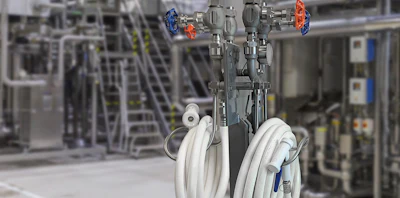
- Enforce Proper Tool and Hose Storage: Hoses left on the floor are exposed to heavy foot traffic, forklift damage, chemicals, and other contaminants. Installing heavy-duty hose reels or wall racks off the floor protects and extends hose life while maintaining sanitary boundaries.
- Use Cleaning as an Active Inspection Tool: Sanitation workers should be trained to use washdown tasks as an opportunity to inspect equipment. Operators sweeping or spraying workstations should actively check for minor leaks, loose fittings, cracked guards, or leaking spray nozzles before small abnormalities turn into major line stoppages.
- Separate Tools by Hygienic Zone: Implement clear visual controls and color-coding to separate sanitation tools, hoses, and nozzles between raw, cooked, allergen, and non-food-contact zones, preventing cross-contamination across processing areas.
Optimizing Total Cost of Ownership (TCO) and ROI
Preventive maintenance for washdown equipment is not a secondary cost center—it is a direct driver of Overall Equipment Effectiveness (OEE) and Total Cost of Ownership (TCO). Raising plant sanitation standards and equipment reliability typically yields measurable operational gains:
Availability: Storing functional, well-maintained washdown tools at point-of-use reduces changeover times and prevents sudden equipment breakdowns during pre-op checks.
Performance: Consistent water pressure and properly maintained spray nozzles eliminate operator motion waste, allowing sanitation crews to clean thoroughly in less time.
Quality: Reliable thermal mixing and correct chemical application eliminate organic residues and allergen cross-contact, protecting product consistency and preventing batch rejections or recalls.
Looking at the Road Ahead
Building a resilient sanitation infrastructure requires deliberate planning and ongoing commitment from plant leadership. Plant leaders looking to upgrade their washdown maintenance strategy should focus on two key initiatives:
Start with a Targeted Pilot: Select a high-demand processing room or sanitation station as an initial proof-of-concept area. Calibrate maintenance schedules, train operators, and measure results before rolling out the program facility-wide.
Engage Frontline Operators: Involve sanitation workers and maintenance staff in establishing routine inspection checklists. Frontline engagement builds daily ownership and prevents "lean fade" over time.
Evaluate Current Water Consumption: Analyze and look at your current usage of water within the given area. Are your current nozzles using up too much water? Switching to a low-flow or reduced flow spray nozzle can help stack up water savings for your plant, incorporate sustainability, and lower production costs while maintaining efficiency.
Ultimately, a well-maintained washdown system safeguards the entire manufacturing environment. By investing in regular utility maintenance, plant managers protect their employees, ensure regulatory compliance, and guarantee that production lines start up smoothly every single day.
Jonathan Olson is Associate Product Manager - Process Products at Nelson-Jameson, a leading distributor and value-added partner to the food and dairy processing industry.