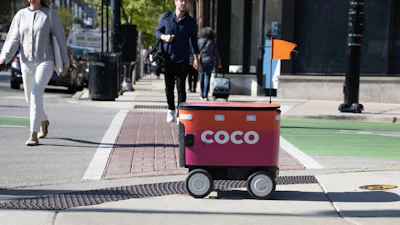
The battle over Chicago's food delivery robots has reached the courts, with two customers accusing the companies behind them of collecting their biometric data without consent.
The men filed separate class-action lawsuits in Cook County court Oct. 9 against Coco Robotics and Serve Robotics, alleging the companies violated a state privacy law. They claim the companies' machines scanned their faces and hands without their knowledge or consent.
Both companies dispute the allegations.
The lawsuits allege the robots' cameras and LiDAR — a technology that sends out laser pulses to measure distances and map the surrounding environment — captured measurements of customers' faces and hands as they approached the machines to retrieve their orders.
Mitchell Breidinger, from the Near North Side, says he ordered groceries through DoorDash in September 2025 and never chose robot delivery. But his order was assigned to a Coco robot, according to his lawsuit. When it arrived, he had to stand close to the machine to enter a code and retrieve his groceries.
Breidinger alleges the robot's cameras recorded his face, head and hands, while its LiDAR sensors measured their geometry. His lawsuit also alleges a remote operator watched video of the delivery in real time. He says Coco did not tell him in writing that it would collect his biometric information, explain how long it would keep the data or obtain his written consent.
Barry Schain, a Lincoln Park resident, alleges a similar experience with Serve Robotics. He says he has received three deliveries from Serve robots, most recently Oct. 4, when an Uber Eats order was assigned to a robot even though he had not selected robot delivery, according to the lawsuit.
Both lawsuits claim the companies retain video and sensor data to train artificial intelligence systems. Schain's lawsuit also points to Serve's disclosures about licensing video and LiDAR datasets to third parties for AI training. Breidinger's lawsuit claims Coco has shared robot-collected data with OpenAI and other third parties.
Customers' biometric measurements are then stored alongside their names and addresses in the companies' data systems, according to the lawsuits, linking the data to identifiable individuals.
The lawsuits accuse the companies of violating the Illinois Biometric Privacy Act, which requires companies collecting biometric data to provide written notice explaining what they collect and why, obtain written consent and maintain a policy for retaining and destroying the data.
Spokespersons for both Coco and Serve denied that the companies collect biometric information from customers or passersby. A Serve spokesperson said the company "will defend against" the lawsuit, while a Coco spokesperson said the company is "confident that this frivolous lawsuit will go away."
"This lawsuit fundamentally misunderstands our technology, we have not collected biometric data in Chicago," the Coco spokesperson said in a statement, adding that complying with privacy laws is a "top priority" for the company.
"The data we share is navigational data used to make sidewalks safer for all users," the Coco spokesperson continued. "For example, we provide real-time sidewalk hazard information to BlindSquare, a navigation app built for people who are blind or have low vision. We do not share data from the beginning or end of delivery trips under our data sharing partnerships. Privacy and compliance with the law are top priorities in everything we do."
The Serve spokesperson said the company's robots use cameras and sensors to navigate sidewalks safely.
"Serve does not use that data to identify individuals and our systems are not designed to identify individuals or create biometric profiles," the spokesperson said in a statement.
The lawsuits seek statutory damages of $1,000 per negligent violation or $5,000 per intentional or reckless violation, as well as other relief.
The lawsuits add to growing scrutiny of delivery robots that have become a regular sight on Chicago sidewalks, where residents have raised concerns about safety, accessibility, surveillance and the potential loss of delivery jobs.
Chicago launched its delivery robot pilot program in 2022 under former Mayor Lori Lightfoot. Coco began operating in the city in late 2024, followed by Serve Robotics in September 2025. The program, overseen by the Chicago Department of Transportation and the Department of Business Affairs and Consumer Protection, is set to expire in May 2027 unless the City Council approves an extension.
Lincoln Park resident Josh Robertson started a petition last year calling on the city to pause the program until officials release safety and accessibility data, hold a public hearing and establish clearer rules. More than 4,500 people had signed the petition as of last month. Residents have reported robots blocking sidewalks and crosswalks, creating obstacles for people with disabilities and raising concerns about cameras recording pedestrians.
The pushback has also reached City Hall. Ald. Daniel La Spata (1st) rejected plans to expand the robots across much of his ward in February after more than 83 percent of residents who responded to an online survey strongly opposed the expansion.
The city has also created a 311 category for residents to report safety concerns and other complaints about the devices.
In March, a Serve robot smashed through the glass of a CTA bus shelter in West Town, scattering shards of glass across the sidewalk. Days later, a Coco robot collided with another bus shelter in Old Town. Both companies said they were investigating the crashes and took responsibility for repair costs.
In September, a video showing more than a dozen Coco robots apparently circling one another and getting stuck on a Lincoln Park sidewalk went viral, drawing hundreds of thousands of views and renewing criticism of the technology.
The companies have defended the robots as a safer, more sustainable option for short distance deliveries that can reduce car trips and traffic congestion.